The Consultant Engagement Pipeline.
The system I built to run my own consulting practice, going from a stranger filling out a form to a client-ready deliverable landing in their inbox, with almost nothing touched by hand in between.
The Pipeline
Intake
Form submitted, no account needed
Qualify
Auto-scored, zero human triage
Discovery Call
The one deliberately human step
Build
All 7 deliverables generated & gated
Close & Onboard
Deposit verified, kickoff drafted
Two sides of the same system.
One simple experience for the client. A fully engineered pipeline underneath it.
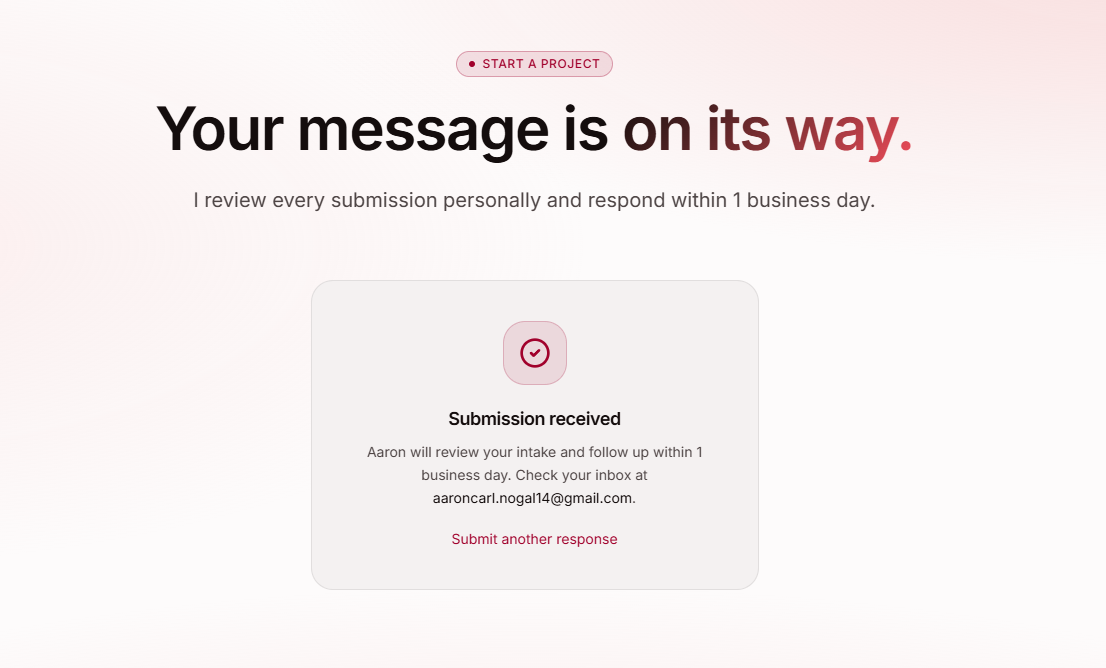
Submit a short intake form
Two minutes, no account needed, just tell me about the business and the problem worth solving.
1 / 6
Payment, Onboarding, & Kickoff System.
Once a client agrees, the system requests and verifies the deposit, delivers the signed contract and receipt, and drafts the kickoff-call agenda, automatically.

Deposit requested
The system computes 50% of the Deal total and Slacks me the exact figure to request from the client.
1 / 8
Why this many workflows?
Each stage runs as its own dedicated workflow on purpose, since small, single-responsibility pieces are easier to build, test, and review individually. Every workflow here went through a manual, node-by-node review before going live, and carries its own execution log and Slack alerting, so a failure anywhere is caught and traceable immediately instead of buried inside one giant, unreadable pipeline.
That's a deliberate tradeoff for reliability and safe iteration while proving the system out, not the smallest possible footprint. For a leaner deployment, several of these could reasonably be consolidated: folding the shared sub-workflows into their callers, or combining the infrastructure jobs into one scheduled workflow. That's an option on the table for your build, not a constraint of the approach.
Verification, not vibes: every one of these workflows was proven against a real, live execution, not just a passing validation check, before I called it done.
Built on boring, replaceable parts.
Nothing here is exotic. Each piece does one job and can be swapped for whatever a business already runs, which is the point: the architecture should outlive any single vendor in it.
n8n
Self-hosted on a private VPS. Every stage runs as its own workflow, with its own execution log and alerting.
Supabase
Postgres for prospects, deliverables, and versioned revisions, plus Storage for call recordings and rendered PDFs.
HubSpot CRM
Holds the Contact, Deal, and custom deliverable records. Both human review gates are real Tasks here, not a bespoke UI.
OpenRouter
One integration point in front of every model, so a model can be swapped without touching the build.
Claude
Reads the discovery transcript and drafts all seven client deliverables, each into a strict output schema.
Whisper
Turns the raw discovery recording into the transcript everything downstream reasons over.
Resend
Sends every client-facing message: the acknowledgement, the booking link, the proposal, and the onboarding kit.
Slack
Pipeline activity and failure alerts both land here, so the whole system can be monitored from one channel.
Gotenberg
A self-hosted converter that turns the branded HTML proposal into the combined PDF the client receives.
Cloudflare Pages
Hosts this site and the intake form that starts the whole pipeline.
Codex
Used alongside Claude to build and review the system itself. Not part of the runtime, unlike everything above it.
Want a system like this built for your business?
This isn't a mockup. It's the same engineering discipline I'll bring to your operations: architected, built, and proven before it ever touches a real client.